
...
Conventional coagulation remains one of the most widely used processes for removing suspended solids, organic compounds, and certain metal contaminants from water. Aluminum- and iron-based coagulants destabilize particles, allowing them to aggregate into larger flocs that can be removed through sedimentation and filtration.
However, coagulation efficiency can become difficult to maintain when organic compounds interfere with metal removal or when increasing chemical dosage produces undesirable residuals.
Research into natural powdered clinoptilolite suggests that adding a mineral adsorbent to the coagulation process can provide another route to improved treatment performance.


A pilot-scale study with significant results
In 2007, researchers M. Valentukeviciene and M. Rimeika published Development of a Fluidized Batch Process Using Natural Powdered Zeolite (Clinoptilolite) in the Polish Journal of Environmental Studies.
Their investigation focused on groundwater from Lithuania’s Neringa Region, where elevated concentrations of organic substances complicated conventional treatment. Humic and fulvic acids formed stable complexes with dissolved metals, particularly iron, making these contaminants more difficult to remove through existing processes.
The researchers evaluated conventional chemical coagulation and compared its performance with a process incorporating natural powdered clinoptilolite. Their pilot-scale system used aeration, aluminum sulfate coagulation, a fluidized contact reactor, sedimentation, and subsequent filtration.
At a powdered-clinoptilolite dosage of 5 g/L and an approximate contact time of 45 minutes, the enhanced process produced substantial improvements in the quality of treated water.
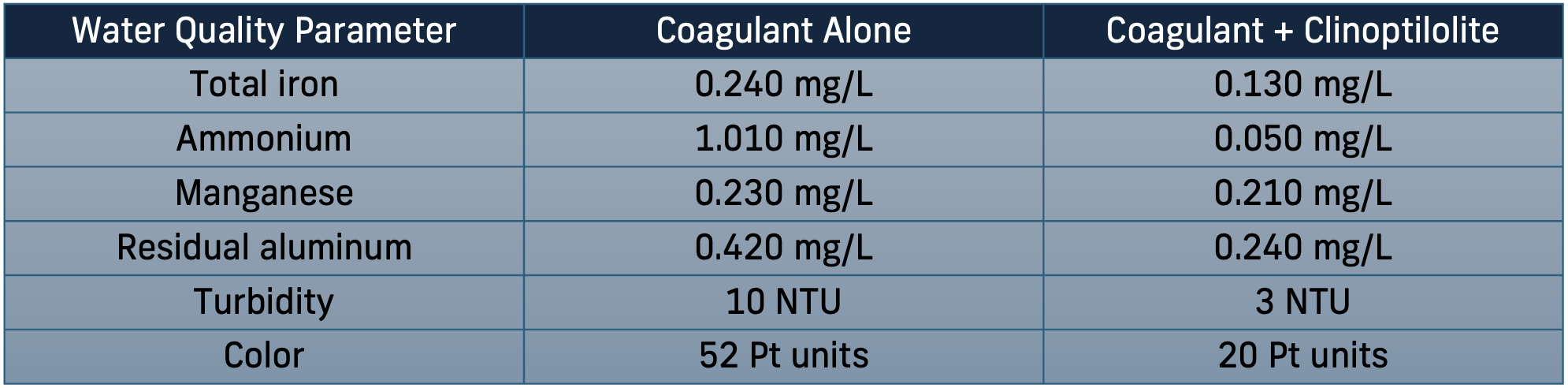
Measurements after sedimentation, using 15 mg/L aluminum sulfate and the 5 g/L powdered-clinoptilolite condition. Table 2, p. 286.
Clear, Significant Improvement when Clinoptilolite is Incorporated.
With the coagulant dosage held at 15 mg/L, the addition of powdered clinoptilolite reduced turbidity by a further 70%, ammonium by approximately 95%, and residual aluminum by approximately 43%, relative to the coagulant-only treatment results.
The researchers achieved these improvements without increasing the aluminum sulfate dosage, effectively isolating the additional improvement associated with incorporating clinoptilolite into an existing coagulation process.
Why powdered clinoptilolite makes a difference
Clinoptilolite is a naturally occurring crystalline aluminosilicate with a negatively charged framework, exchangeable cations, and a porous structure.
Unlike conventional coagulants, which primarily act through charge neutralization and particle destabilization, clinoptilolite introduces additional mechanisms for contaminant capture.
These include cation exchange, adsorption, and interactions between mineral surfaces and contaminants in suspension.
The Lithuanian study demonstrated the advantages of using these mechanisms alongside conventional coagulation. Rather than relying exclusively on increased coagulant dosage, the researchers incorporated powdered clinoptilolite to improve the overall removal of contaminants.
It is important to distinguish the processes involved. The results do not establish that clinoptilolite alone caused all the observed reductions. Instead, they demonstrate that powdered clinoptilolite can enhance the performance of a combined treatment system.
Translating the research into NextFloc applications
Next Filtration Technologies manufactures NextFloc, a finely processed natural clinoptilolite media available in −40 mesh and 60-cycle-milled forms.
NextFloc is intended for applications where powdered mineral media can be introduced into a treatment process rather than contained in a conventional granular filtration vessel.
The enhanced coagulation research identifies several applications worth evaluating:
-
Raw water clarification: Incorporating NextFloc into an existing rapid-mix or flocculation process where organic compounds interfere with treatment.
-
Coagulant optimization: Evaluating whether mineral-assisted coagulation can improve removal performance without increasing chemical dosage.
-
Industrial wastewater pretreatment: Supporting separation of suspended and dissolved constituents before downstream processing.
-
Filtration pretreatment: Reducing contaminant loading on downstream filters by improving upstream removal.
The −40 mesh grade provides a starting point for evaluating mineral-assisted coagulation in systems capable of mixing and separating powdered media.
The more finely processed 60-cycle grade may be of interest where faster particle-to-water interactions are desired, although its relative performance must be established through testing.
Practical considerations for operators
The Lithuanian researchers reported a relatively high experimental zeolite dosage of 5 g/L, equivalent to 5,000 mg/L. That dosage should not be interpreted as a recommended commercial NextFloc dose.
Their treatment system also incorporated mineral recovery and recycling, with approximately 70% of the powdered zeolite recycled into the reactor.
For full-scale application, operators must consider particle size, contact time, chemical compatibility, solids loading, separation equipment, and mineral recovery or disposal.
Jar testing is an appropriate first step to determine how NextFloc performs with actual plant water and existing treatment chemicals.
An additional tool for coagulation optimization
The significance of this research is not that clinoptilolite replaces conventional coagulation. Rather, it demonstrates how a naturally occurring mineral can improve a treatment process that otherwise depends primarily on chemical addition.
For facilities experiencing inconsistent clarification, elevated residual contaminants, or difficulty treating organic-rich water, powdered clinoptilolite deserves consideration as a supplemental treatment material.
NextFloc provides an opportunity to investigate these benefits using a purpose-milled clinoptilolite product supplied by Next Filtration Technologies.
Reference: Valentukeviciene, M., & Rimeika, M. (2007). Development of a Fluidized Batch Process Using Natural Powdered Zeolite (Clinoptilolite). Polish Journal of Environmental Studies, 16(2), 283–288.