
In water treatment, “multi-media” has long been considered the standard benchmark for depth filtration. By layering coarse anthracite over fine garnet and silica sand, multi-media filters attempt to catch larger solids at the top and finer solids near the bottom.
However, comparative particle-size studies reveal that NextSand delivers superior performance in a single-media bed, eliminating the need for complex, multi-layered vessels.
Let’s look at the data from two real-world head-to-head field tests.
Field Test 1: Ground Water RO Pre-Filtration (Bottled Water Plant)
Over a 5-month evaluation conducted by plant operators and a consulting Chemical Engineer, a bottled water production facility tested parallel 48-inch FRP filter tanks using groundwater drawn from a storage tank:
-
Tank A (Multi-Media): 36-inch bed depth composed of #16 Garnet, #50 Garnet, 20×40 mesh sand, and anthracite.
-
Tank B (NextSand): 36-inch bed depth of mesh NextSand over a gravel support bed.
Results
NextSand outperformed the multi-layered bed across Total Suspended Solids (TSS), Turbidity, and Silt Density Index (SDI). Crucially, NextSand operated at half the backwash frequency of the multi-media system. Because NextSand’s deep-bed structure allows solids to load throughout the entire depth of the bed rather than surface-blinding, the plant halved its backwash water consumption while producing higher-purity feed water for its RO unit.
Field Test 2: Surface Water Particle Removal (San Antonio River Water)
To test extreme turbidity conditions, a 6-day head-to-head trial was conducted using river surface water laden with silt and clay particles following a heavy rain event in San Antonio. Both systems were operated side-by-side at a flux rate of with a 36-inch bed depth.
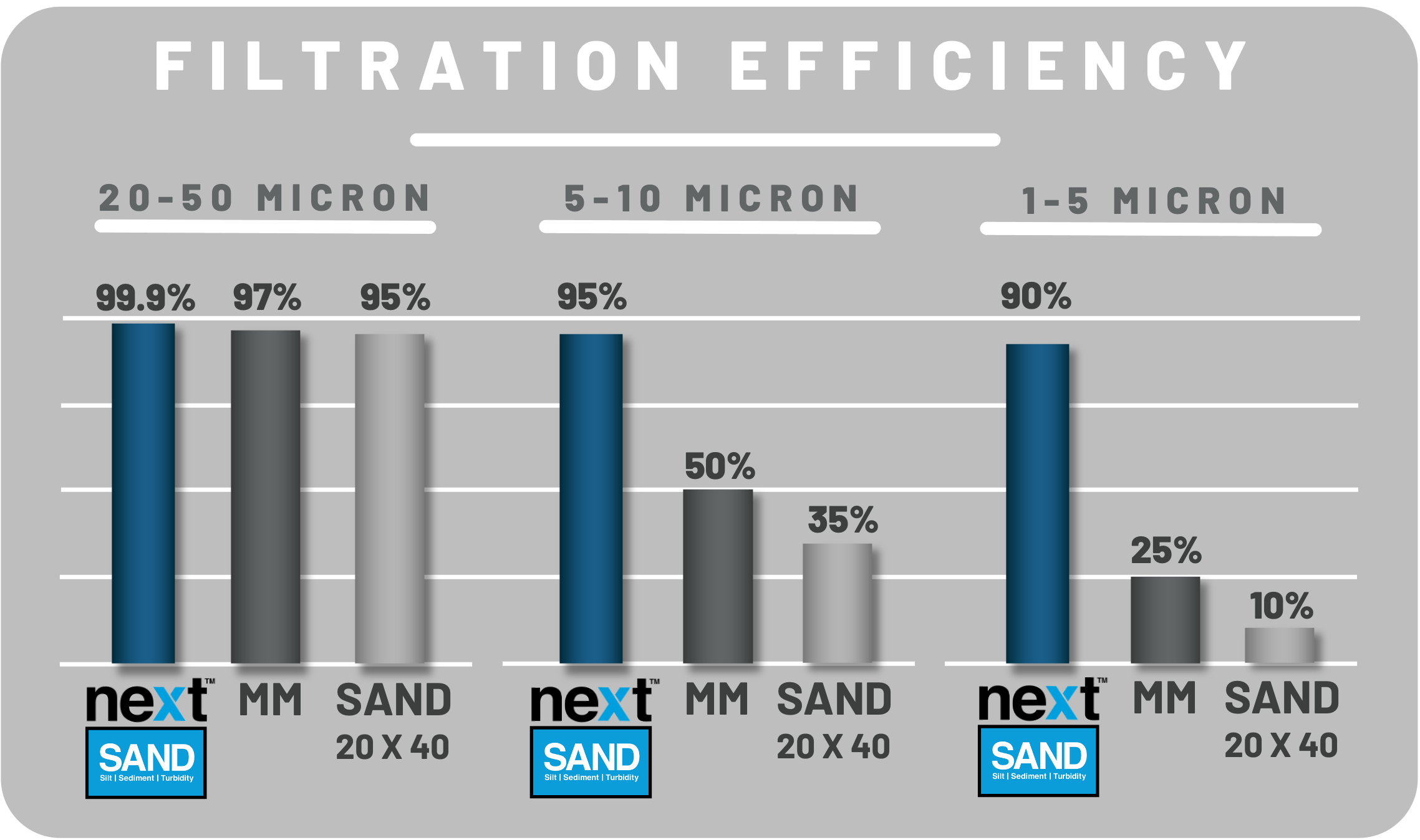
Key Efficiency Metrics:
-
Coarse Particles (20–50 microns): NextSand achieved 99.9% removal, compared to 97% for multi-media and 95% for standard sand.
-
Medium Particles (5–10 microns): NextSand removed 95% of particles, whereas multi-media only captured 50% and sand captured 35%.
-
Fine Particles (1–5 microns): NextSand maintained a 90% removal efficiency. Multi-Media plummeted to 25%, and standard sand dropped to a negligible 10%.
Why NextSand Wins on Physics and Economics
How does a single-media bed drastically outperform a multi-layered garnet and anthracite filter?
-
Surface Area & Sub-Micron Capture: Standard silica sand relies entirely on physical straining between grains. NextSand’s mineral structure contains extensive internal micro-porosity and a high surface area, capturing fine silt and colloids through both straining and surface-charge attraction.
-
Replacing Cartridge Filters: The particle size analysis proved that NextSand performs as well as—or better than—most 5-micron disposable cartridge filters. Incorporating NextSand upstream can extend downstream cartridge filter life or eliminate the need for routine cartridge replacements altogether.
-
Double the Solids Holding Capacity: In both field tests, NextSand required half as many backwash cycles. Less frequent backwashing means higher net water yield, lower pumping costs, and less wastewater generation.